
Hesperia Previous Residents Sources
A house-history trail needs more than one kind of record. Deeds show title parties and legal descriptions. Assessor history connects an APN to the parcel and tax-roll context. Census schedules show a household at a historical enumeration point. City or regional directories may show an address-first listed occupant. Permits date construction or change. Probate and obituaries can close a person's trail. Each source has a start date, access rule, and blind spot.
| Source | Years it covers | Where held | What it shows |
|---|---|---|---|
| Recorder official index | 1925-present | ARC online and Hesperia counter | Document number, date, title, grantor, and grantee |
| Recorder images and deeds | Indexed 1925-present; older path unverified online | Counter, ordered copy, or county inquiry | Legal description, vesting, signatures, and transfer details |
| Assessor PIMS and parcel history | Current plus historical views; exact span varies | County PIMS or Assessor office | APN bridge, situs, mail context, values, and parcel history |
| Federal census | Public through 1950 under the 72-year rule | NARA, FamilySearch, library databases | Named household, relationships, ages, birthplace, occupation |
| Directories and criss-cross volumes | Hesperia run not officially verified | Library, HeritageHub, or genealogy database | Dated name-to-address or address-to-listed-occupant snapshot |
| Permits, probate, and obituaries | Case or report dependent | City, Superior Court, library, newspaper, archives | Physical change, estate role, death clue, or family context |
The coverage table is a plan for a backward trail. It does not claim that every year has a searchable name or that every occupant appears. Previous residents are most persuasive when an address, date, and role agree across at least two independent sources.
Hesperia Past Residents Parcel Starting Point
Begin with today's parcel rather than today's occupant. Run the address through the Hesperia City geocoder, select the county parcel polygon, and record the APN, legal-description clues, tract or map references, and adjoining pattern. Use the Assessor Property Information route to separate situs from mailing address and to inspect current, parcel-history, and roll-value context. The assessor warns that its data is not a legal-title determination, so the current assessed name is a bridge to the recorder, not the conclusion.
Large lots, flag parcels, subdivision common areas, and parcels created during the 1954 Phillips and Dempsey development campaign can make a present street label misleading. A legal description and APN often survive changes in postal wording. If the parcel appears vacant or improved at a later date, permits and assessment characteristics can help date the physical site while leaving the question of occupancy open.
- APN
- The county assessor's parcel identifier used to connect map and property systems.
- Legal description
- Recorded lot, block, tract, or metes-and-bounds wording that anchors land continuity.
- Situs
- The physical location of the assessed parcel.
- Mailing address
- The destination for tax or assessment correspondence, which may not be the parcel.
Hesperia Past Residents Deed Chain Backward
The recorder's Official Records Index does not accept a street address. Find the current parcel and likely owner through the assessor, then search that person or entity as a grantee. Select an acquisition deed by date, document title, document number, legal description, and party role. The seller is the grantor on that deed. Search the seller as a prior grantee and repeat. The chain becomes stronger when each step stays tied to the same parcel, tract, legal description, co-owner, and chronology.
- Confirm the target address in the City geocoder and county parcel layer.
- Capture APN, situs, mailing context, map book, tract, and parcel-history clues from the assessor.
- Search the recorder index for the likely acquisition instrument and inspect grantor, grantee, date, and title.
- Use the prior seller as the next grantee search, preserving every document number and legal-description clue.
- Separate deeds, deeds of trust, reconveyances, liens, easements, and maps so a security interest is not mistaken for a transfer.
- View the document at the Hesperia counter or order a copy when the index cannot answer the vesting question.
A title chain is not an occupancy chain. A builder, family trust, investor, estate, lender, or public entity can hold an interest without living at the parcel. Previous residents need a directory, census, obituary, permit, or other dated household clue alongside the deed.
Hesperia Past Residents Recorder Boundary
The online recorder index reaches 1925 to the present. The public site gives document number, date, title, grantor, and grantee, but not the image. ARC says document contents can be viewed at the Hall of Records or High Desert Government Center. The Hesperia counter is useful for a house-history project because it can display a document that the web index only describes. Earlier deed books, grantor and grantee books, maps, and archives require a local inquiry instead of an invented date range.
The county document-recording guidance is shown in this house-history image. 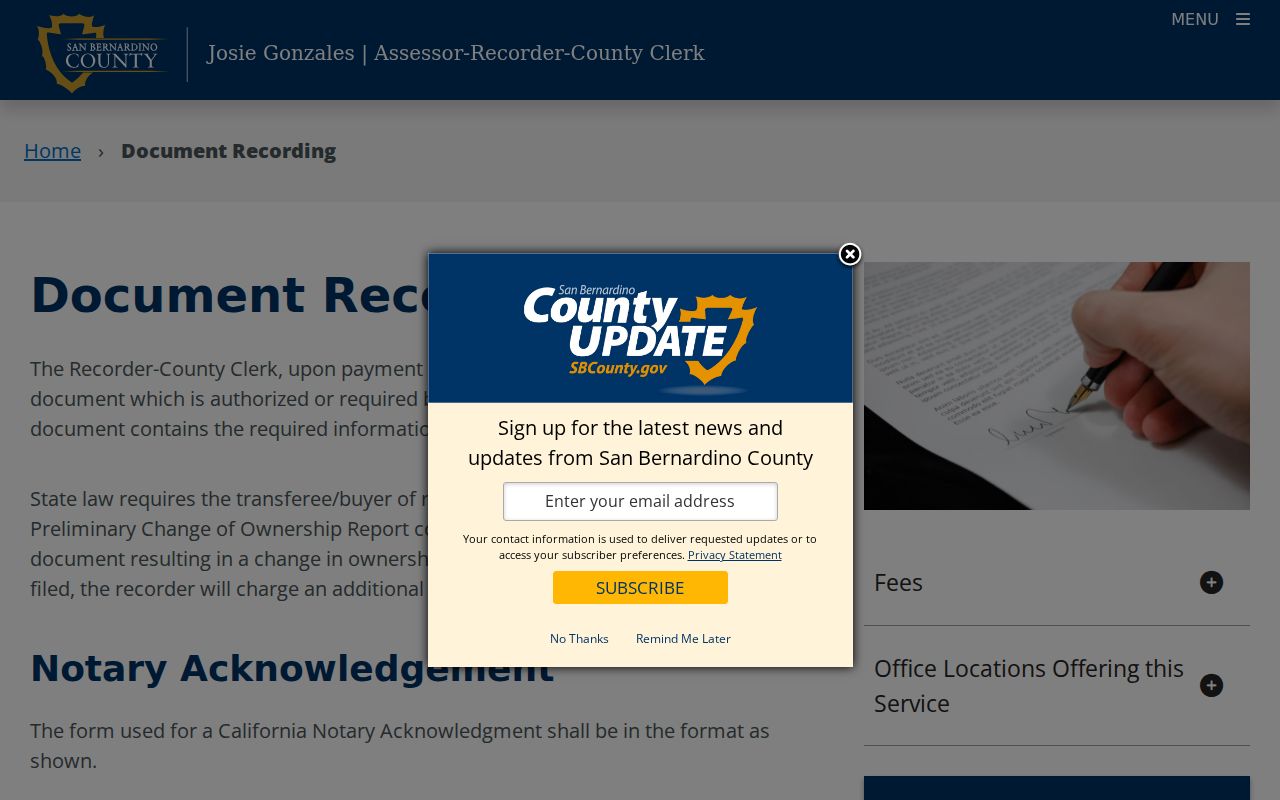 Recording procedure explains how an instrument enters the chain, while the separate official-records index supplies the search metadata.
ARC publishes $4 for the first copy page, $1.50 for each later page, and $1.50 per page for certification under seal. Mail fees and card surcharges can change, so confirm the live page. The fee calculator estimates a request but is not binding.
Hesperia Directory Snapshots
City and criss-cross directories can put a listed name at an address between census years. Hesperia-specific publisher and year coverage remains unverified, so search the Hesperia Branch catalog, HeritageHub, Victor Valley terms, telephone-directory terms, and Polk or Cole terms. If a volume is found, copy the entry, page, publisher, date, address form, spouse or occupation notation, telephone, and abbreviation key. Search both alphabetical and reverse sections.
A directory occupant is not automatically an owner. A person may appear at a house while the deed remains in another name, and an owner may never appear in a directory. Compare a directory year with the deed chain, census, permit dates, obituary, or probate role. If a street name or number looks different, use APN, tract, lot, legal description, and cross streets before deciding that the address changed.
The complete collection treatment lives on the Hesperia city directories page. This backward trail uses a directory as a dated household snapshot, not as a catalog of all previous residents.
Hesperia Past Residents Census Cross-Checks
The federal census is especially useful for previous residents because it records relationships, ages, birthplaces, occupations, and household structure that deeds omit. The latest public schedule is 1950 under the 72-year release rule. Older Hesperia-area households may be listed under a township, precinct, or enumeration district before the city incorporated. A census location is historical geography, not a modern city boundary.
National Archives census guidance is the source shown in this house-history image. 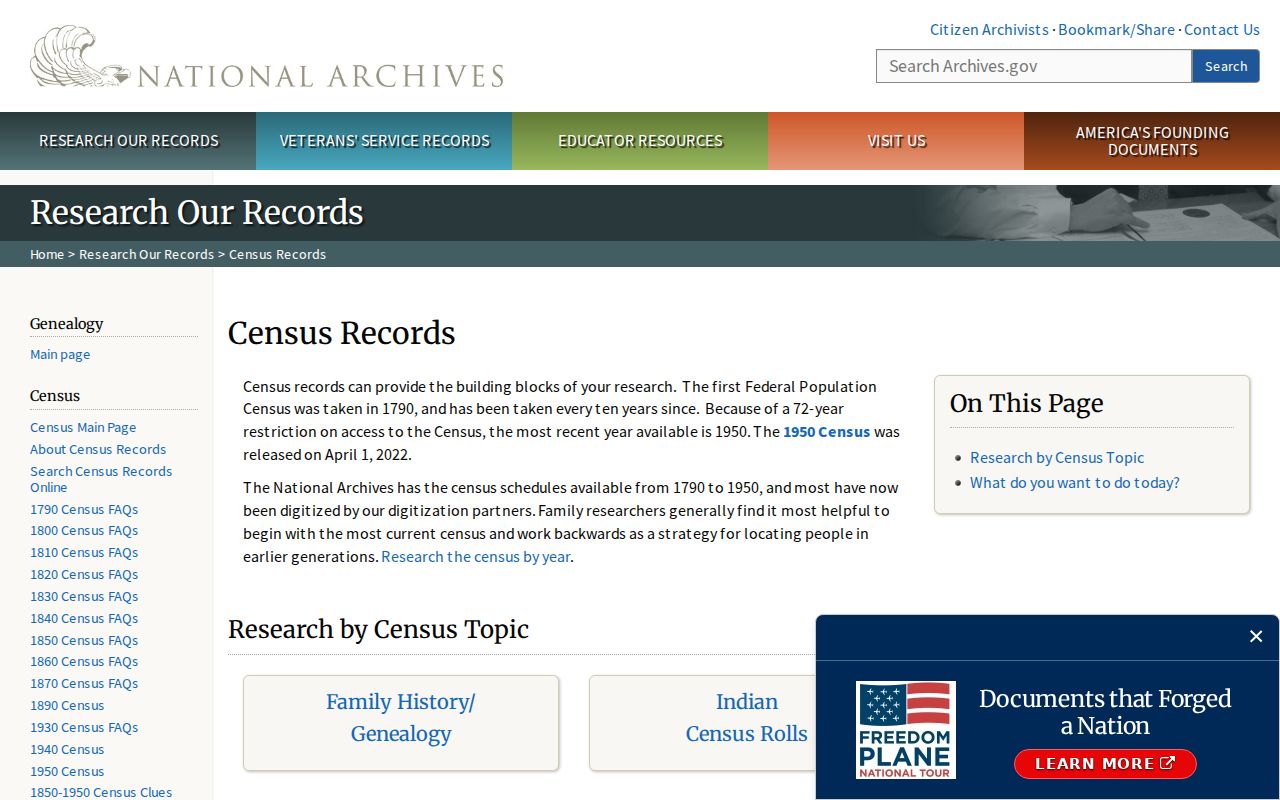 The census schedule can test a directory clue, but the two sources may use different address and boundary systems.
| Cross-check | What to compare |
|---|---|
| Directory versus census | Name, age, relationship, occupation, address, and enumeration geography. |
| Census versus deed | Household at a place versus title party on the parcel. |
| Census versus obituary | Family relationships and dates, subject to notice accuracy. |
| Census versus permit | Household presence versus the date a structure or project changed. |
Hesperia Past Residents Permits and Change
Building permits and inspection reports can place a structure, addition, pool, demolition, or other project in time. Hesperia's Permit Center publishes activity summaries and inspection reports, and the City provides a Request to Review Records route. Request by exact address and APN, with a date range and desired record type. A permit number, inspection date, address or APN, project type, result, applicant, or contractor can explain a change in the property trail.
Permit evidence does not say who lived there. A permit applicant may be an owner, contractor, authorized agent, or project participant. Code cases have their own privacy and redaction rules. If a physical improvement appears after a long deed gap, use the permit and assessor characteristics as chronology, then seek a directory, census, newspaper, or probate record for the household question.
Hesperia's Permit Center is the starting point for an address-specific record request. Its public reports should be treated as date and project evidence, not a roster.
Hesperia Past Residents Probate Endpoints
Probate can close a previous resident's trail when a death led to an estate transfer. Search the Superior Court CAP for a public probate case, note the decedent, personal representative, heirs or notices that are visible, and follow any later deed in the recorder index. An obituary or cemetery notice can supply the first name and date. The recorded transfer can connect the estate to the parcel, while the directory or census supplies better evidence of who occupied it.
Use at least two facts to connect a probate party to a Hesperia address. Match the case number, legal description, APN, relative, deed date, and known chronology. Do not infer that every heir lived at the property or that a death notice contains the full legal family. Confidential filings and sealed records remain outside a general search.
The Hesperia Recorder-Clerk counter is shown in this house-history image. 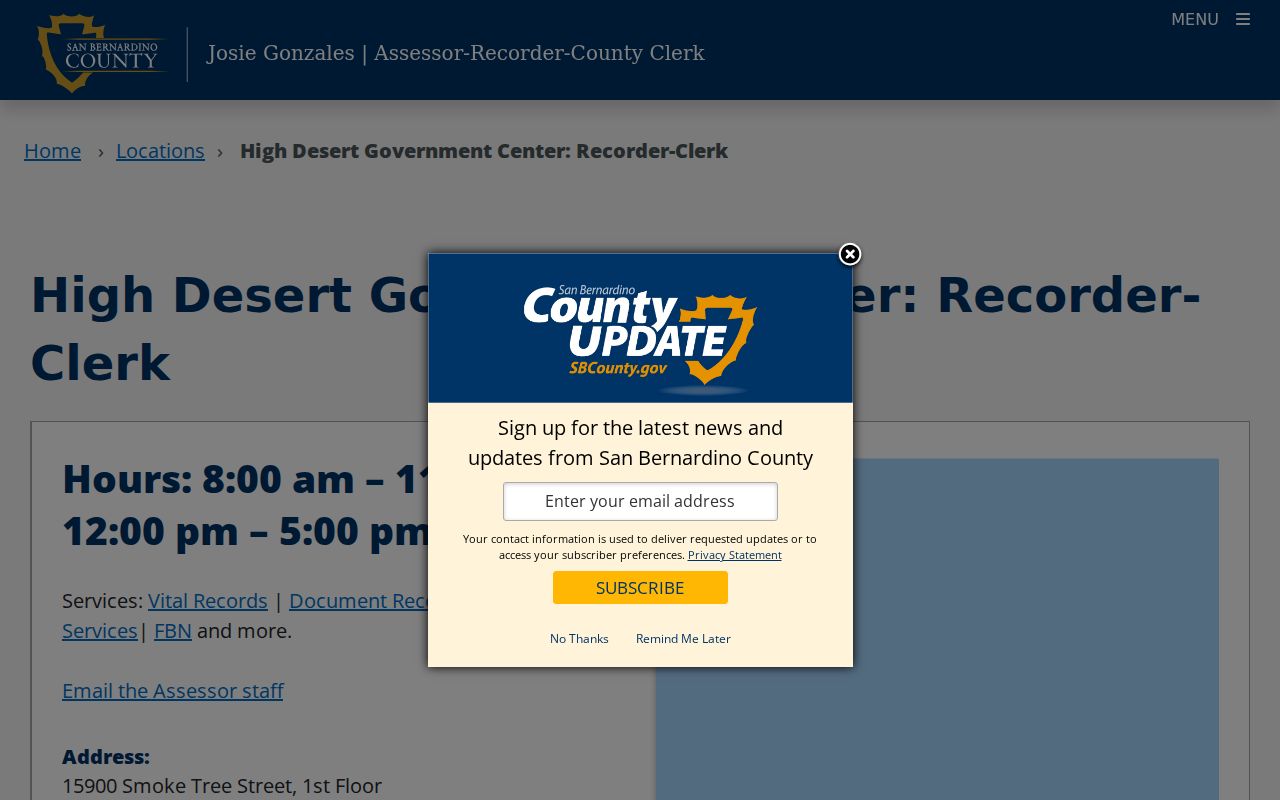 Local access matters when an estate deed or older record cannot be read online.
Hesperia Past Residents Address Continuity
Hesperia's research file did not locate an authoritative citywide street-renumbering year, a complete old-to-new address concordance, or a dedicated house-history guide. Preserve every address form exactly as printed, then compare legal description, APN, tract, lot, map book, cross streets, and postal city. A pre-1988 record may be county-created. A railroad, ranch, subdivision, Route 66, or large-lot clue may explain why the same land appears under different place names.
The county's fee-calculator page is shown in this house-history image. 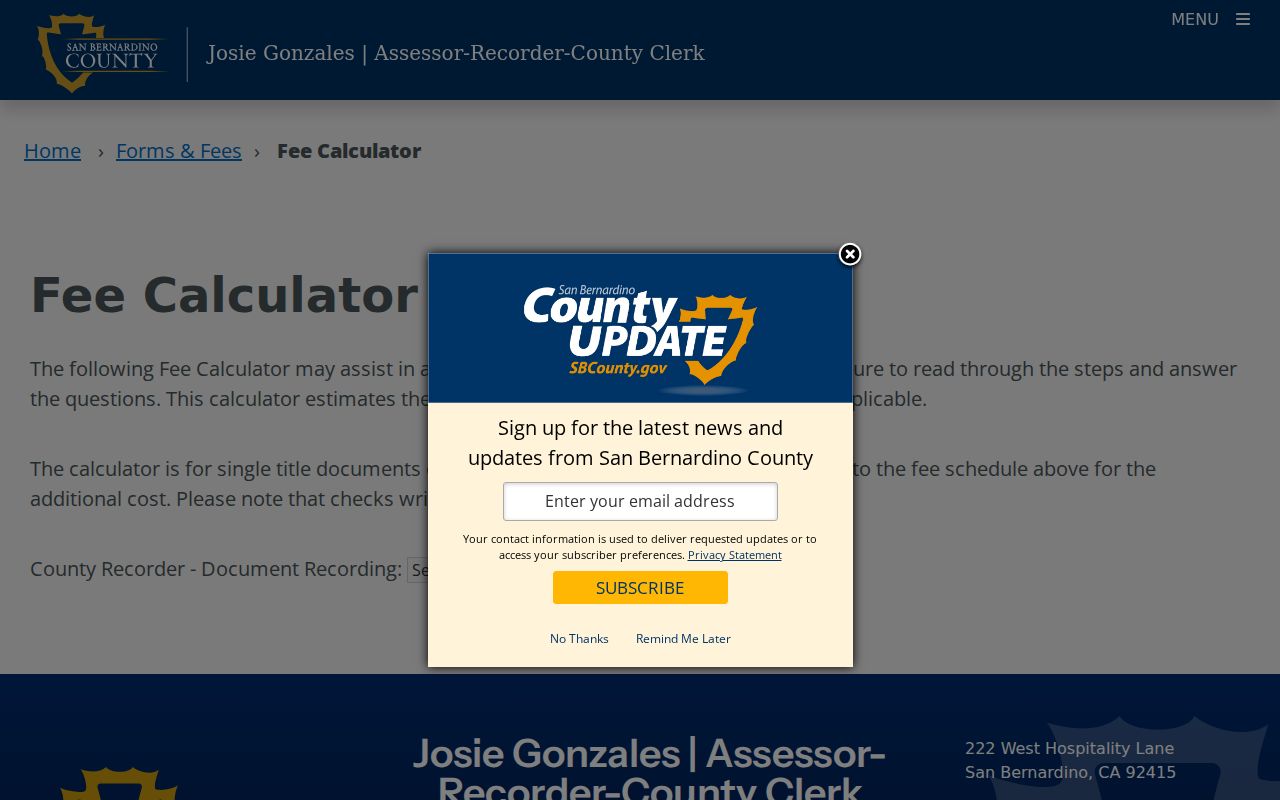 A cost estimate helps plan a copy request, but the live county page controls the current amount and the estimate does not prove that a document exists.
San Bernardino County Historical Archives is the right fallback for a pre-digital record-group question. Its archives route is shown here.  Provide a name, place, record type, and date rather than asking the archivist to assemble an unbounded household history.
Hesperia Previous Residents Limits
Previous owners and previous residents are not the same category. Deeds show title parties. Directories and census schedules show dated listed households. Permits show projects. Probate shows estate roles. Obituaries show reported family facts. The chain can leave out family members, other occupants, people using a protected address, and anyone who never entered a public source. A gap should be labeled as unknown rather than filled with a name from a weak compilation.
House-history use. Use previous-residents research for family history, property history, and lawful estate work. Do not use a deed chain or directory trail to stalk, harass, intimidate, or expose another person.